

Bridge
Bridge is a mechanical structure that lets you walk out into the middle of a body of water with nothing connecting you to shore. You walk on steps that rise up out of the water in front of you and disappear back under behind you. You can only go to the middle, there is no way back from there except to turn round carefully and return the way you came. The mechanism has no power, it's driven by the weight of the person on it. So far I've only made it indoors in galleries, but it's ultimate ambition is to exist in a permanent installation in a lake.
Beginning work on Bridge was a turning point in my practice, it was the first project I'd made that I felt unequivocally was worthwhile. Everything I'd done until I then made me feel uneasy. I'd made successful
projects that were well received but I was painfully aware that I was a participant in a culture of appearances and acquisition that I was deeply perturbed by. Bridge encompassed all my best aspirations. It's almost ten years now since I started working on it, but I still feel exactly the same.
You might ask why it's in my "current projects" section given that the pictures are from 2006, that's simple; it's because it's not finished and I'm still working on it. I obsess about this project. I lie awake at night and think about how to make it work better, how to get the money and where to put it. I save up my cash to pay for it and I always have a new prototype mechanism in my workshop.

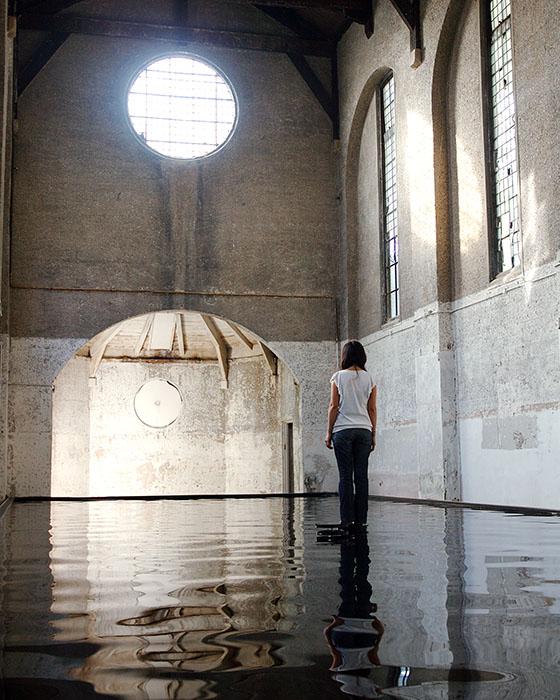
The story of Bridge (so far)
Conceptually this project is very simple so it only took a moment to conceive. I was sitting in a talk and I was in a bad mood, the speaker showed a picture of a very small but very expensive looking pier like structure and said it was one step into the water
and I thought no it's not - and anyway who only wants to go one step.
I spent the rest of the evening working in my head, designing a system that would let you get right out to the middle of a lake but with nothing connecting you to shore.
I knew from the beginning that I wanted a mechanical system, not one with power. This was partly practical and partly philosophical. A mechanical system should ultimately be more durable, but more than that it would mean that the piece met a sensible balance of cost. When I say cost
I don't mean money. What I mean is that although you could get to a similar looking end point with a lot of computers, sensors and hydraulics I wouldn't see that as worthwhile - it whould just be too much stuff to justify the outcome. I want to achieve this with lightness of touch, balance and wit, not by force of technology and cash. The material existence of the mechanism is as important to the piece as what it does so it can't be done right then it shouldn't be done. It's not easy to do it right though, and that has been the essence of the struggle.
More about this is on the way..